010 140 6700 info@ipshealth.co.za
Please note: Orders for delivery in 2025 will close on 18 December 2025. All orders placed after this date will be sent out in the first week of January.

Mini Cart

Wellness Made Simple with IPS Multivitamin for Women

In today’s fast-paced world, it’s easy to forget how much our bodies rely on vitamins, minerals and other nutrients to stay strong and healthy. Every cell, organ and tissue depends on these essential building blocks to keep us energised, resilient and balanced. When our diets fall short, supplementation can help ensure that our bodies get the nutrients they need to function at their best.

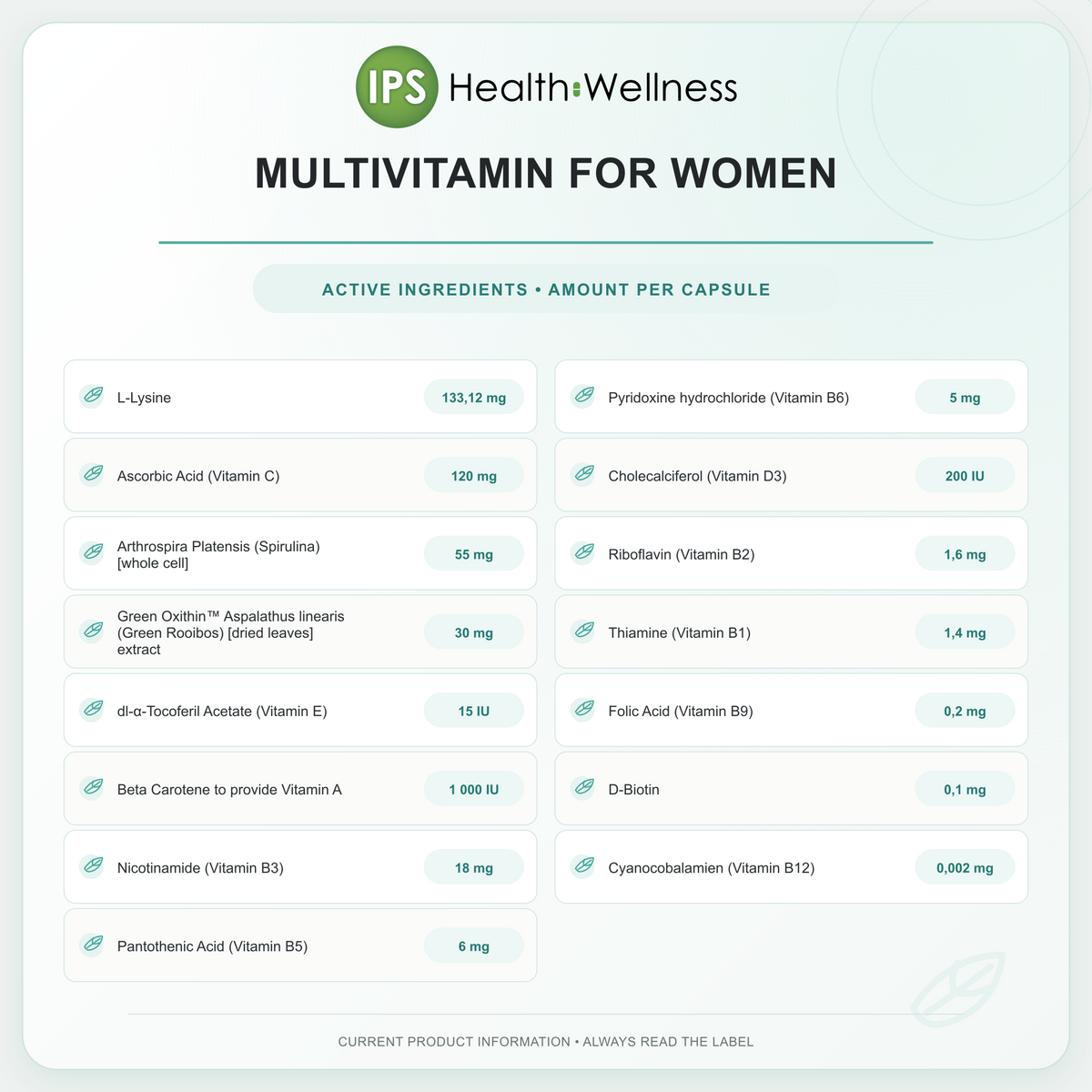
That’s where the IPS Multivitamin for Women comes in. This carefully formulated blend provides essential vitamins, amino acids and plant-based extracts designed to support energy, immunity, bone health, the nervous system and overall wellness. Let’s explore some of the key ingredients and the important roles they play in women’s health.

B Vitamins: The Body’s Energy Drivers

The B vitamin family is central to energy production, metabolism and nervous system function:

  • Vitamin B1 (Thiamine) helps convert carbohydrates, fats and proteins into energy, and supports brain and nerve health. Because the body cannot store much of it, a deficiency can occur quickly if intake is too low (1; 2).
  • Vitamin B2 (Riboflavin) not only supports energy metabolism but also activates other vitamins such as B3 and B6 (3; 4; 5). Research shows that riboflavin deficiency is surprisingly common, particularly among women (6; 7; 8).
  • Vitamin B6 (Pyridoxine) plays a role in over 100 biochemical reactions, including the production of haemoglobin and neurotransmitters that regulate mood and cognitive function (9).
  • Vitamin B12 (Cobalamin) is crucial for healthy nerves, red blood cells and DNA synthesis. Deficiency can cause fatigue, memory problems, nerve pain and even infertility (10; 11; 12).
  • Vitamin B9 (Folic Acid) supports red blood cell development and DNA synthesis, while also working with B12 to maintain the nervous system (13; 14).


Together, these vitamins don’t just provide energy; they may help maintain concentration, memory, coordination and overall nervous system function.

Other Essential Vitamins

Beyond the B vitamins, several other vitamins play equally important roles:

  • Vitamin C acts as a powerful antioxidant, supporting collagen production for healthy skin, tissue repair, wound healing and immunity (15).
  • Vitamin D3 helps the body absorb calcium and phosphorus for strong bones. Low levels are linked to osteoporosis in adults and rickets in children (16; 17).
  • Vitamin A supports vision, growth and immune function (18; 19).
  • Vitamin E, another strong antioxidant, helps protect cells from oxidative stress (20).


Amino Acids for Repair and Growth

Proteins are built from amino acids, and one of the most important is L-Lysine. As an essential amino acid, it must come from diet or supplements. Lysine supports collagen production, tissue repair and immune function (21; 22; 23; 24). It is often lacking in grain-heavy diets, making supplementation helpful for many people (25; 26).

Plant-Based Antioxidants

Alongside vitamins and amino acids, natural plant compounds also play a powerful role in supporting health:

  • Green Oxithin™, our patented green rooibos extract, is rich in antioxidants and has been linked to heart health, brain protection and anti-inflammatory benefits (27).
  • Spirulina, a nutrient-dense blue-green algae, provides protein, vitamins and antioxidants. Studies suggest it may improve cardiovascular health, reduce allergy symptoms, enhance immune function and protect nerve cells from oxidative stress (28).


The Bigger Picture: How the IPS Multivitamin for Women Can Support You

While each nutrient has specific roles, their combined effects are what truly support whole-body health. For example:

  • Energy production fuelled by B vitamins, vitamin C and Spirulina.
  • Nervous system health supported by vitamins B1, B6, B12, folic acid, vitamin E and Spirulina.
  • Wound healing aided by vitamin C, lysine and vitamin E.
  • Antioxidant protection strengthened by vitamins C, E, A, B2, Green Oxithin™ and Spirulina.
  • Bone health maintained by vitamin D3, vitamin C and calcium absorption.
  • Immune defence aided by vitamins A, C, D, E, B6, B7, B12, lysine and Spirulina.
  • Skin, hair and nail health supported by biotin, lysine, vitamin C and vitamin A.


By working together, these nutrients don’t just help prevent illness – they actively promote vitality and long-term wellbeing.

In conclusion: nutrients are more than just “dietary add-ons” – they are essential for life. Whether it’s B vitamins fuelling energy production and supporting nerves, vitamin D strengthening bones or Spirulina enhancing immunity, every nutrient in the IPS Multivitamin for Women gives your body the support it needs to thrive every day.

References

  • 1. The importance of thiamine (vitamin B1) in humans. Mrowicka, Małgorzata, et al. 43, 31 October 2023, Bioscience Reports, Vol. 10.
  • 2. Vitamin B1 in critically ill patients: needs and challenges. Collie, Jake T.B, et al. 11, 22 April 2017, Clinical Chemistry and Laboratory Medicine (CCLM), Vol. 55.
  • 3. Riboflavin: The Health Benefits of a Forgotten Natural Vitamin. Suwannasom, Nittiya, et al. 3, 31 January 2020, International journal of molecular sciences, Vol. 21.
  • 4. Vitamin B2 (Riboflavin). Peechakara, Basil V, Sina, Reddog E and Gupta, Mohit. s.l. : StatPearls Publishing, January 2025, StatPearls [Internet].
  • 5. Riboflavin Deficiency. Mahabadi, Navid, Bhusal, Aakriti and Banks, Stephen W. s.l. : StatPearls Publishing, 17 July 2023, StatPearls [Internet].
  • 6. Riboflavin deficiency in Madang infants. Oppenheimer, S J, Bull, R and Thurnham, D I. 1, Papua and New Guinea medical journal, Vol. 26, pp. 17-20.
  • 7. Micronutrient intakes and potential inadequacies of community-dwelling older adults: a systematic review. ter Borg, Sovianne, et al. [ed.] 1195-1206. 8, 30 March 2015, British Journal of Nutrition, Vol. 113.
  • 8. Poor thiamin and riboflavin status is common among women of childbearing age in rural and urban Cambodia. Whitfield, Kyly C, et al. 3, 7 January 2015, The Journal of nutrition, Vol. 145, pp. 628-633.
  • 9. Brown, M J, et al. Vitamin B6 Deficiency. StatPearls [Internet]. s.l. : StatPearls Publishing.
  • 10. Ross, Catharine A, et al. Modern nutrition in health and disease: Eleventh edition, pp. 390-398.
  • 11. Stabler, S P. Vitamin B12. [book auth.] B P Mariott, et al. [ed.] 11. Present Knowledge in Nutrition. Washington, DC : Elsevier, 2020, pp. 257-271.
  • 12. Vitamin B12 deficiency: Recognition and management. Langan, Robert C and Goodbred, Andrew J. 6, 15 September 2017, American family physician, Vol. 96, pp. 384-389.
  • 13. Folate, folic acid and 5-methyltetrahydrofolate are not the same thing. Scaglione F, Panzavolta G. 5, May 2014, Xenobiotica, Vol. 44, pp. 480-488.
  • 14. Merrell, B J and McMurry, J P. Folic Acid. StatPearls [Internet]. s.l. : StatPearls Publishing.
  • 15. Abdullah, M, Jamil, R T and Attia, F N. Vitamin C (Ascorbic Acid). StatPearls [Internet]. s.l. : StatPearls Publishing.
  • 16. Kaur, J, et al. Vitamin D Deficiency. StatPearls [Internet]. s.l. : StatPearls Publishing.
  • 17. Al-Hashimi, Nazik and Abraham, Sherly. Cholecalciferol. StatPearls [Internet]. s.l. : StatPearls Publishing.
  • 18. McEldrew, E P, Lopez, M J and Milstein, H. Vitamin A. StatPearls [Internet]. s.l. : StatPearls Publishing.
  • 19. Delivery of retinoid-based therapies to target tissues. Moise AR, Noy N, Palczewski K, Blaner WS. 15, 17 Apr 2007, Biochemistry, Vol. 46, pp. 4449-4458.
  • 20. Medina, J and Gupta, V. Vitamin E. StatPearls [Internet]. s.l. : StatPearls Publishing.
  • 21. L-lysine dietary supplementation for childhood and adolescent growth: Promises and precautions. Gunarathne R, Guan X, Feng T, Zhao Y, Lu J. April 2025, J Adv Res, Vol. 70, pp. 571-586.
  • 22. Application of amino acids in the structural modification of natural products: A review. Xu Q., Deng H., Li X., Quan Z.S. 2021, Front Chem, Vol. 9, pp. 1-26.
  • 23. Pandey AK, Pandey K, Singh L K. Microbial production and applications of l-lysine. [book auth.] R. R. Mishra, & C. O. Adetunji (Eds.) P. Mishra. Innovations in Food Technology: Current Perspectives and Future Goals. s.l. : Springer Singapore, 2020.
  • 24. Medicinal uses of l-lysine: Past and future. Singh M., Rao D.M., Pande S., Battu S., Mahalakshmi K., Dutt K.R., et al. 4, 2011, Int J Res Pharm Sci, Vol. 2, pp. 537-642.
  • 25. Review of lysine metabolism with a focus on humans. Matthews, D E. 2020 : s.n., J Nutr, Vol. 150, pp. 2548S-S2555.
  • 26. Protein, lysine and vitamin D: critical role in muscle and bone health. Aggarwal R., Bains K. 9, 2022, Crit Rev Food Sci Nutr, Vol. 62, pp. 2548-2559.
  • 27. Neuroprotective and anxiolytic potential of green rooibos (Aspalathus linearis) polyphenolic extract. López, C, et al. 91, Nov 2022, Food Funct.,, Vol. 13, pp. 91-101.
  • 28. Algae Supplementation for Exercise Performance: Current Perspectives and Future Directions for Spirulina and Chlorella. Gurney T, Spendiff O. 7 Mar 2022, Front Nutr, Vol. 9, p. 865741.